A bird's-eye view: firm costs and the limits of habitat protection
Best Paper Award, 3rd Modern Finance Conference, Kraków 2026
Best PhD Paper Award, Global Research Alliance for Sustainable Finance and Investment 2025 (for an earlier version)
Abstract
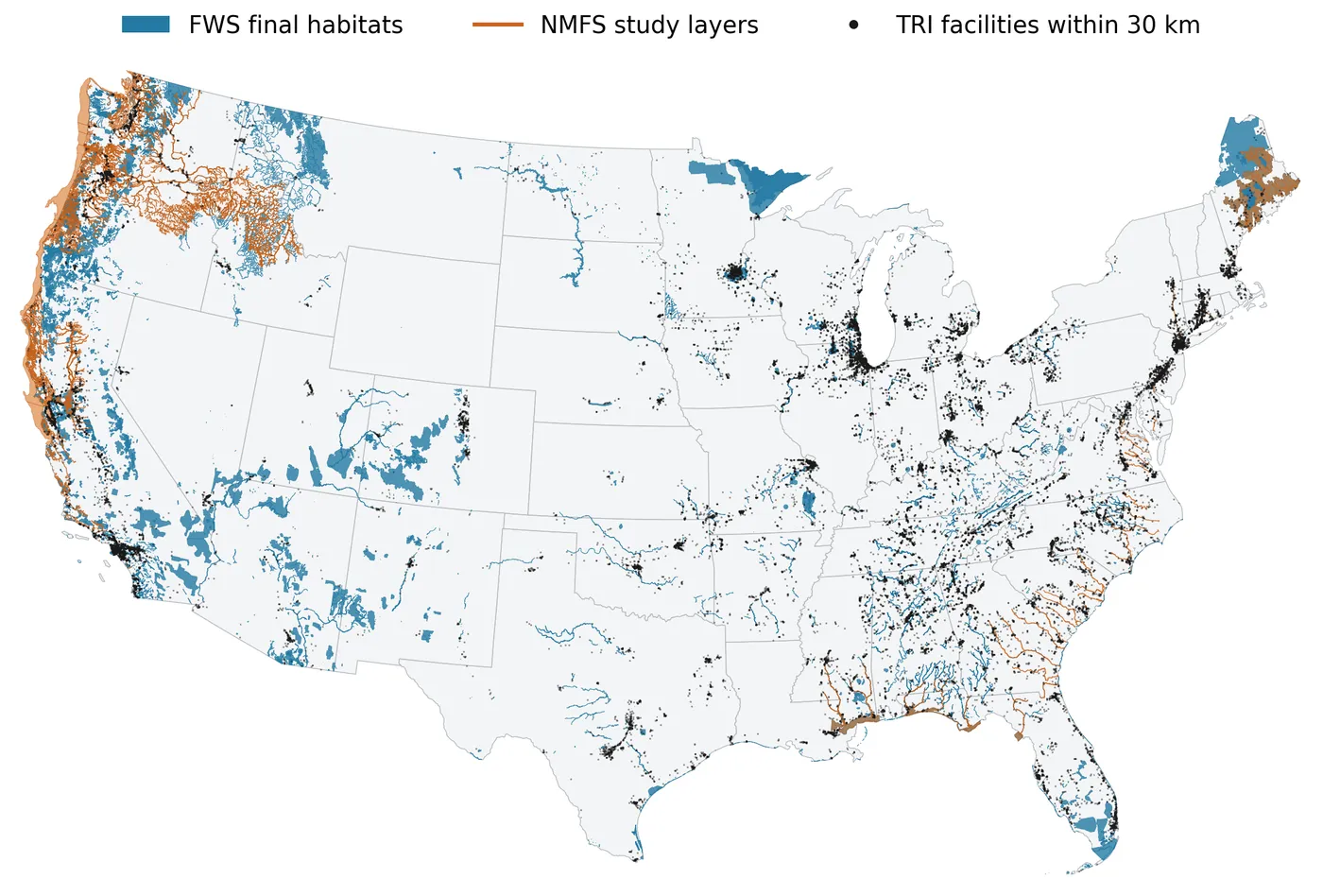
The U.S. Endangered Species Act protects the habitats of threatened species by designating spatially explicit areas that restrict the operations of nearby firms. Using geographic designations under the Act, I show that these protections are associated with greater operating costs and lower profitability for firms with facilities only within a few kilometers of the area. However, I provide causal evidence that these facilities reduce bird populations—a proxy for local ecology—over a much wider area, with effects detected up to 18 km away. Protections do not undo the damage, as bird populations near designated habitat recover only partially. Costs rise with the concentration of polluting activity near protected habitat and coincide with greater regulatory scrutiny, increased employment, and reductions in the most toxic pollutants. In addition, voluntary disclosures and biodiversity ratings provide little information about this exposure, limiting the scope for market-based incentives to reduce ecological harm.
Overview
The current draft is available on request — please email me.
The U.S. Endangered Species Act protects threatened species by designating critical habitat: mapped areas whose protections reach private firms through federal permits and project approvals, including for activities outside the boundary that may affect the habitat within it. This paper asks how far the ecological effects of industrial facilities extend, and what habitat protection costs the firms that operate nearby.
To measure ecological reach, I combine facility locations from the EPA’s Toxics Release Inventory with millions of citizen-science bird observations from eBird and construction dates inferred from satellite imagery. Difference-in-differences estimates show that within 18 km of a new facility, bird abundance falls by 6–9% and species richness by 3–5%. The declines begin at construction and persist.
The costs of protection are far more local. When critical habitat is designated within 3 km of a firm’s facility, its cost of goods sold rises by 1.53 percentage points of sales, about $31 million a year for the median firm, and its operating margin falls by 1.81 points. Protected-area designations that carry no new obligations have no such effect. Costs rise most for firms with more of their pollution near the habitat, especially highly leveraged ones, and designation brings more enforcement and a shift toward less toxic chemicals.
This spatial mismatch limits what protection achieves: bird populations near designated habitat recover only partially. Voluntary ESG reports, 10-K filings, and biodiversity footprint scores largely fail to identify the exposed firms, which limits the scope for investors to complement regulation.
An earlier version of this work circulated as “Firm operations, biodiversity loss, and corporate disclosure”, which received the Best PhD Paper Award at the Global Research Alliance for Sustainable Finance and Investment (GRASFI) 2025.
Presentations
- NBER Climate Finance Conference, Cambridge MA, October 2026 (upcoming)
- FMA Annual Meeting, Tampa, October 2026 (upcoming)
- Cambridge Judge Business School seminar, October 2026 (upcoming)
- 3rd Modern Finance Conference, Kraków, September 2026
- Aarhus Finance Forum, August 2026
- International Symposium on Climate, Finance, and Sustainability, Paris, June 2026
- 3rd Workshop on Recent Trends and New Developments in Sustainable, Green & International Finance (EDHEC Nice), June 2026
- Climate Finance & Business Conference, Concordia University
- University of Ljubljana
- Cambridge Judge Business School Brown Bag Seminar
- 2nd Financial Fraud, Misconduct and Market Manipulation Conference (Lancaster University), September 2025
- 26th BIOECON Annual Conference, St John's College, Cambridge, September 2025
- Global Research Alliance for Sustainable Finance and Investment, August 2025
- Sustainable and Impact Investments International Conference, Dublin, January 2025